
Aluminum Composite Panel vs. Solid Aluminum Panels: Facade and Signage Head-to-Head
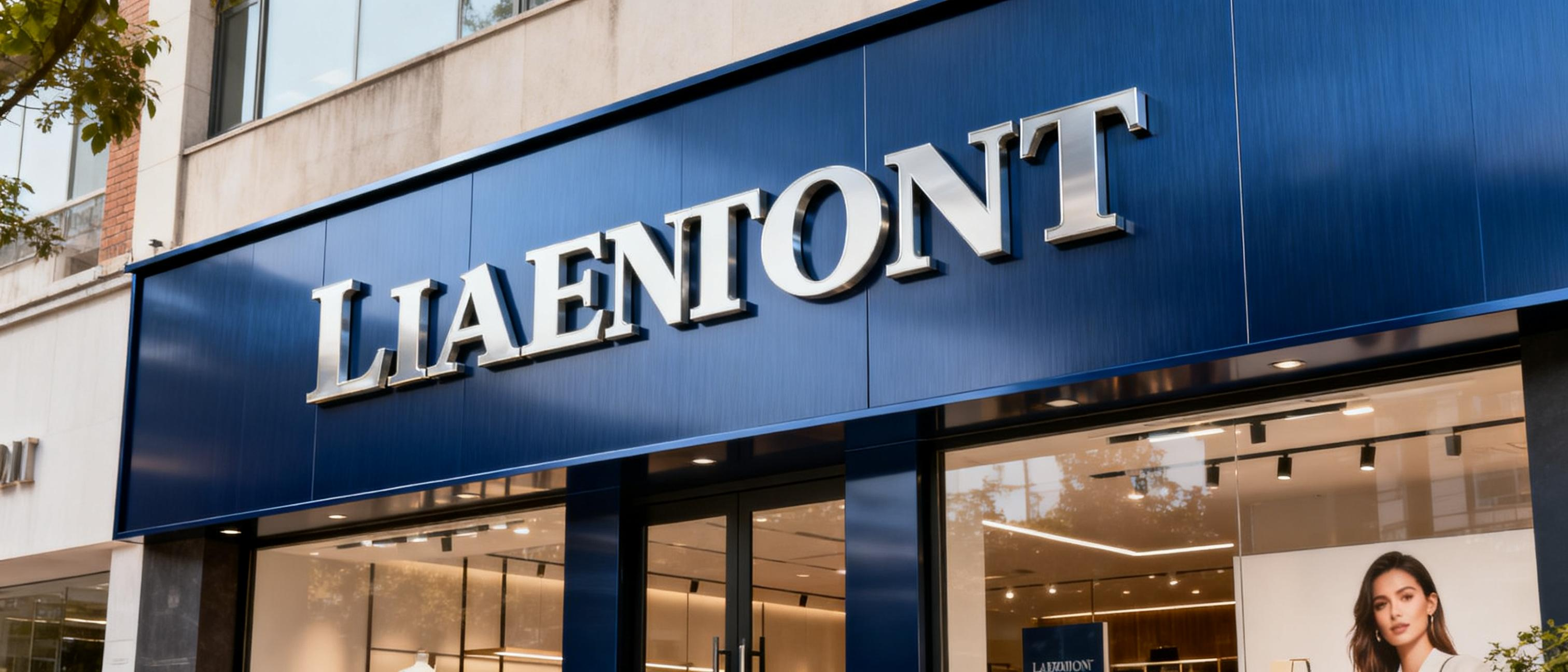
Aluminum composite panel (ACP) and solid aluminum panel both begin with aluminum, but they behave very differently once they reach a facade or a sign face. ACP is a bonded sandwich: two aluminum skins over a polyethylene (PE) or fire-resistant mineral core. A solid aluminum panel is a single aluminum sheet with the same material through its full thickness. That one structural difference drives almost everything a project buyer cares about — panel weight, structural load, handling, installation method, finish options, and total project cost.
For most facade and signage projects, ACP is the practical default. It is commonly around 50% lighter than solid aluminum of comparable panel size and typically lands 30% to 60% lower in total project cost, because lighter panels reduce framing, lifting, and installation labor. Solid aluminum takes over when a project needs maximum rigidity, higher impact resistance, or deep dimensional forming that a bonded composite panel cannot provide. Weight and cost figures are planning values; confirm them against your own drawings, framing system, and local labor rates.
Problem Definition: What a Facade or Signage Buyer Is Actually Deciding
The ACP versus solid aluminum question rarely arrives as a materials-science question. It arrives as a set of project constraints that must be resolved before a specification is issued. In facade work, the constraints are structural and regulatory. In signage work, they are usually about weight, format, forming method, and how the sign face will survive outdoor exposure.
In practice, the decision reduces to six checkable items:
- Structural load: how much dead load the curtain wall, sign structure, or existing frame must carry, and whether the substructure can accept it without redesign.
- Handling: whether large panels can be lifted, positioned, and fixed with the labor and equipment available on site.
- Installation method: whether the design calls for routed and folded cassettes on a keel and suspension system, or for flat sheets mechanically fixed to a frame.
- Budget: whether the project is measured in material price per square meter or in total installed cost, including framing, fixings, labor, and maintenance.
- Compliance: whether the local building code requires a fire-rated core and a tested wall assembly for the facade.
- Appearance: whether the surface must carry a PVDF coating, or a mirror, brushed, wood grain, or marble grain finish to meet a design intent.
Framing the choice this way matters because the two materials are not interchangeable at the assembly level. A lighter panel changes the substructure, the hoist plan, the number of installers, and often the schedule. A heavier panel changes all of those in the opposite direction.
How the Two Panels Are Built
Material construction is the root cause of every downstream difference, so it is worth stating precisely before comparing performance.
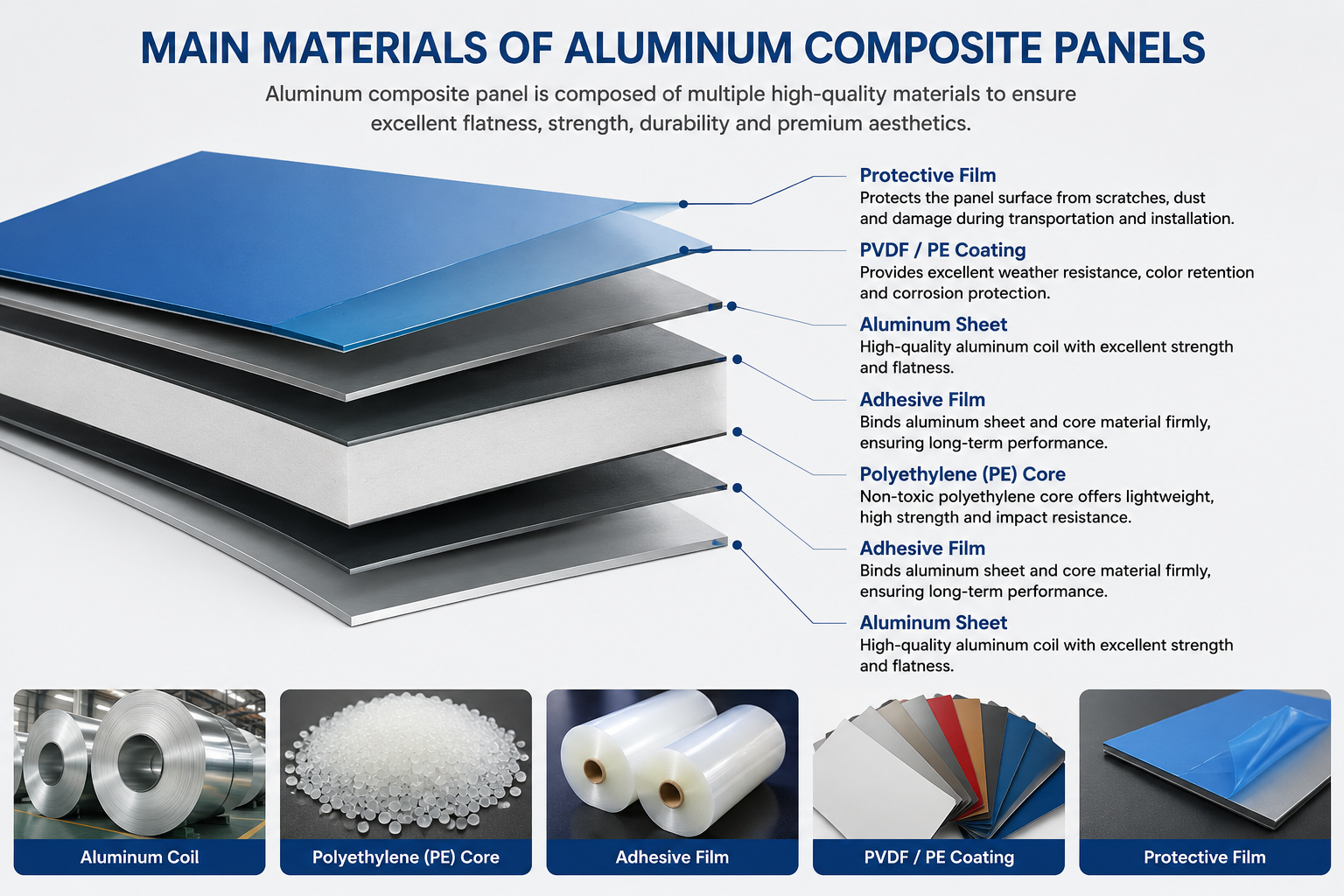
Aluminum composite panel construction
Aluminum composite panels are primarily made of high-quality aluminum coils, a polyethylene (PE) or fire-resistant mineral core, high-performance adhesive films, and durable PVDF or polyester (PE) coatings. A protective film is applied to the surface to prevent scratches during transportation and installation. The aluminum skins are thin relative to the finished panel: aluminum thickness ranges from 0.05 mm to 0.50 mm, and alloy grades available are AA1100, AA3003, and AA5005, with other grades on demand.
Available specifications include panel thicknesses of 3 mm, 4 mm, 5 mm, 6 mm, and 8 mm, and normal widths of 1220 mm, 1250 mm, and 1500 mm. Core material options are PE core and fireproof core, and colour is accepted as a customization, including OEM production.
Solid aluminum panel construction
A solid aluminum panel is a single aluminum sheet. There is no core and no adhesive interface, so the panel's stiffness comes entirely from the thickness and temper of the metal itself. The panel contains no non-metallic core layer, and the surface is typically supplied mill, anodized, or painted, depending on the supplier and the design intent. Because the whole section is aluminum, a format that is light in composite form becomes substantially heavier in solid form.
The consequence: stiffness-to-weight versus raw stiffness
The bonded composite build delivers high stiffness relative to weight. Two thin aluminum skins separated by a core act together to resist bending, so a 4 mm ACP panel can present a flat, dimensionally stable face while weighing a fraction of a solid aluminum sheet of similar format. A solid aluminum sheet delivers raw stiffness and impact resistance, but it does so with more mass per square meter — mass that the substructure, the fixings, and the installers must all carry.
Industry Background: Why This Comparison Has Become Sharper
The global aluminum composite panels market was valued at USD 6.9 billion in 2025 and is projected to reach USD 12.1 billion by 2033 (Grand View Research). Within that market, polyvinylidene fluoride (PVDF) coated panels accounted for the largest revenue share at 36.5% in 2025, and fire retardant panels are estimated to hold a 53.6% share by 2025 as global building safety codes tighten (Future Market Insights). China remains the top global exporter of aluminum composite panels by shipment volume (Eximpedia).
The regulatory direction is equally clear. In Europe, ACP fire behaviour is classified under EN 13501-1, where facade assemblies typically require A2-s1,d0 or B-s1,d0 ratings. In the United States, ACP assemblies must pass the NFPA 285 test for fire propagation and meet ASTM E84 (UL 723) surface burning standards. Global supply is led by established manufacturers including 3A Composites (Alucobond), Mitsubishi Chemical (Alpolic), Arconic (Reynobond), and Alucoil (Mordor Intelligence).
Two consequences follow for a project buyer. First, the coating matters as much as the panel: PVDF systems dominate the market because they are specified for outdoor colour and gloss retention. Second, the composite versus solid aluminum choice is increasingly a compliance and load decision as much as a budget decision. A fire-rated mineral core is available in composite form, but the panel and the assembly must be specified correctly and confirmed against the project fire strategy before the order is placed. This is where facade buyers should focus their technical review, not on brand preference alone.
Head-to-Head Comparison: ACP vs. Solid Aluminum Panels
The table below compares the two materials on the criteria that decide facade and signage specifications. Cost, weight, and format values are planning figures taken from standard material data and should be confirmed against your own drawings and framing system.
| Decision factor | Aluminum composite panel (ACP) | Solid aluminum panel |
|---|---|---|
| Build-up | Two aluminum skins bonded to a PE or fire-rated mineral core with high-performance adhesive film | A single aluminum sheet, same material through the full thickness |
| Weight and dead load | Commonly about 50% lighter than solid aluminum of comparable panel size; lower load on framing and fixings | Heavier per panel; the substructure and fixings must carry the additional mass |
| Available formats | Panel thickness 3, 4, 5, 6, 8 mm; normal width 1220, 1250, 1500 mm; aluminum thickness 0.05–0.50 mm; alloys AA1100, AA3003, AA5005, other grades on demand | Supplied as sheet of a specified thickness; format depends on the supplier |
| Handling on site | Lighter panels; large formats can be carried and positioned by fewer installers | Needs more labor or mechanical lifting for the same panel area |
| Fabrication and installation | Routed, folded, and bent into cassettes; installed with keel and suspension systems, aluminum profile framing, adhesives, sealants, and fastening components | Forming requires more force; framing and fixings must be sized for higher weight |
| Rigidity and impact | Flat, consistent large-format surface when properly framed; stiffness comes from the bonded build-up | Higher inherent rigidity; preferred where impact resistance or deep forming is required |
| Surface finishes | PVDF coated, mirror, brushed, wood grain, marble grain, nano self-cleaning, and fireproof types | Mill, anodized, or painted finishes, depending on the supplier |
| Fire performance path | PE core or fireproof core; final rating must be confirmed against the project specification and written into the contract | Aluminum metal contains no combustible core; assembly performance still depends on the complete wall build-up |
| Cost profile | Commonly 30%–60% lower total project cost | Higher material and handling cost for the same covered area |
| Best-fit work | Curtain walls, exterior wall decoration, commercial and retail storefronts, billboards and signage, interior decoration, furniture panels | Impact-critical panels, small rigid sign plates, deeply formed or embossed elements |
Read the table as a load-and-labor problem rather than a materials contest. The weight difference is what makes ACP cheaper to install, and the rigidity difference is what keeps solid aluminum relevant in applications where the panel itself is the structure.
Decision Criteria: What to Verify Before You Specify
1. Structural load and substructure capacity
Start with dead load. ACP reduces the load that the curtain wall or sign structure must carry, which often allows lighter sub-framing and lighter anchors. Solid aluminum raises the load and may require a heavier frame, larger fixings, or additional structural review. If the substructure already exists and cannot be changed, the panel choice is effectively made for you.
2. Handling, logistics, and site access
Handling cost scales with weight and panel size. ACP panels are lighter and can be carried and positioned by fewer installers, which matters on occupied sites, restricted access areas, or projects without a crane. Solid aluminum requires more mechanical handling for the same covered area, and the extra weight also reduces the number of panels that can be moved in a single lift.
3. Installation and fabrication method
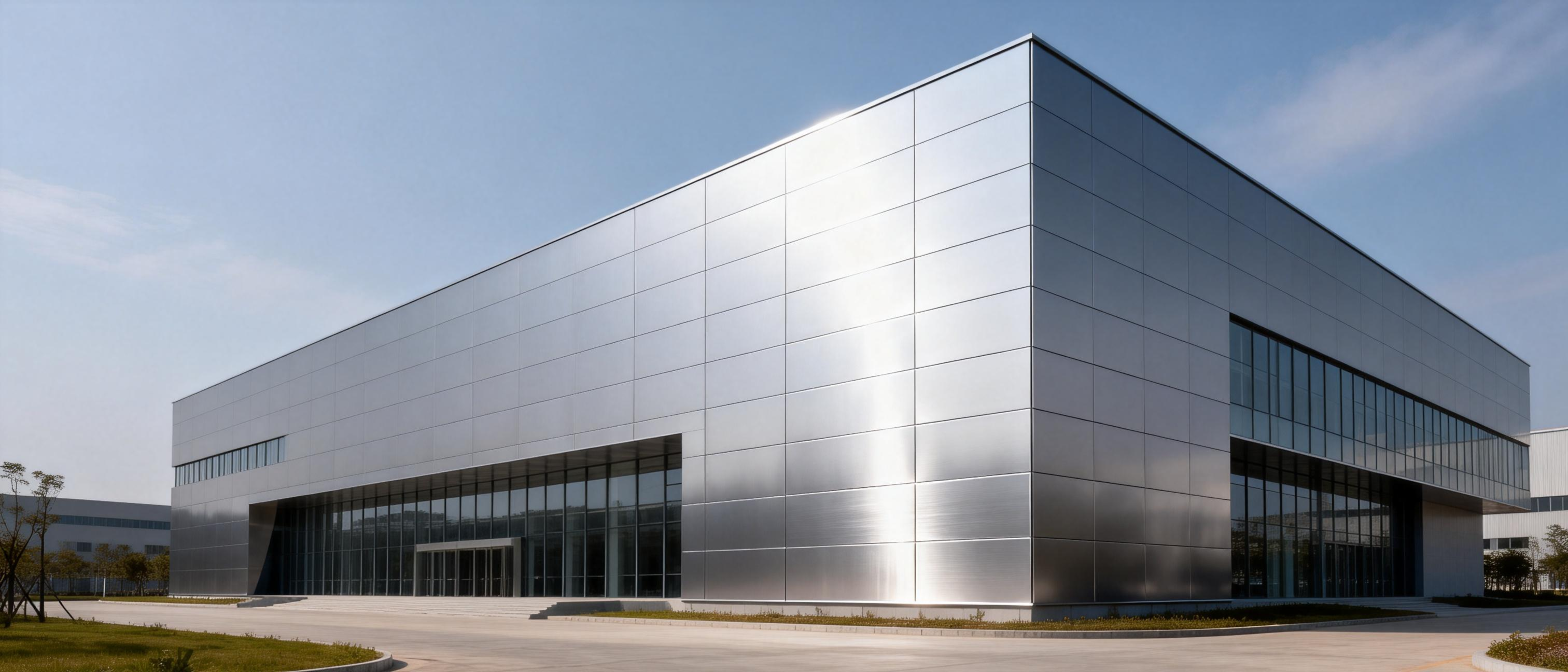
ACP is designed for fabrication: the panel can be routed, folded, and bent into cassettes and installed on keel and suspension systems with aluminum profile framing, adhesives, sealants, and fastening components. The specific supporting parts are determined by the project structure, and installation guidance should be requested from the supplier during the specification stage. Solid aluminum sheets can also be formed, but the required force is higher and the framing must be sized for more weight.
4. Budget structure: material price versus installed cost
Panel price alone is a poor comparison metric. The meaningful number is installed cost per square meter, which combines panel price, framing, fixings, handling, labor, and expected maintenance. Because ACP is commonly about 50% lighter, and total project cost typically runs 30% to 60% lower than solid aluminum, the gap usually widens after installation is priced, not narrows. The exact figure depends on panel thickness, aluminum skin thickness, alloy, coating system, core type, surface finish, and local labor rates.
5. Surface, finish, and service environment
ACP offers PVDF coated, mirror, brushed, wood grain, marble grain, nano self-cleaning, and fireproof panel types, so a single material can deliver very different architectural appearances. For outdoor exposure with weather and UV resistance requirements, the coating system and finish grade should be confirmed against the service environment rather than assumed. These are passive fixed installations: they consume no continuous energy in service, and the maintenance cycle depends on the surface coating and the environment where the panels are installed.
6. Fire and code compliance
Fire performance should be treated as a specification item, not a marketing label. Composite panels are available with a PE core or a fireproof core, and the required rating must be confirmed against the project specification and stated in the contract. Where EN 13501-1, NFPA 285, or ASTM E84 (UL 723) applies, the compliance evidence should cover the assembly as designed, not only the panel.
7. The cases where solid aluminum still wins
ACP is not a universal replacement. Solid aluminum remains the better specification where the panel is impact-critical, where the design requires deep forming, embossing, or sharp small-format rigidity, or where the substructure is already sized for the heavier load. In those cases the correct decision is to stay with solid aluminum and control cost elsewhere in the project.
Project Fit: Where Each Panel Wins
Application type is usually the fastest filter. The categories below reflect the industry applications that ACP is designed for, and the counter-cases where solid aluminum holds the advantage.
- Building curtain wall and exterior wall decoration: ACP. Large flat formats, lighter dead load, and available fireproof core options for facade compliance.
- Commercial and retail storefronts: ACP. Fast fabrication, low handling weight, and a wide finish range for brand-driven storefront design.
- Advertising and signage, billboards: ACP for large sign faces and folded cassette signage; solid aluminum for smaller rigid plates, hardware-mounted elements, or faces that must take direct impact.
- Interior decoration, ceilings, and wall cladding: ACP. Light weight is an advantage for ceiling grids and interior partitions.
- Furniture and cabinet manufacturing: ACP. Double-sided panels replace solid wood and reduce paint-related work.
- Impacts, deep forming, and embossed sign work: solid aluminum. Rigidity and forming depth matter more than weight savings here.
Step-by-Step: Choosing and Specifying in Six Steps
- Define the surface and the exposure. Interior or exterior, coastal or high-UV, permanent facade or replaceable sign face. Exposure determines the coating system and the maintenance expectation.
- Set the structural and code requirements. Confirm the fire performance requirement, wind and span conditions, and the load the existing substructure can accept. This is the step that most often eliminates one material.
- Compare installed cost, not panel price. Price panel, framing, fixings, handling, labor, and maintenance per square meter. Expect ACP to land 30% to 60% below solid aluminum in total project cost, with the gap driven mainly by weight.
- Choose the build-up. For ACP, that means panel thickness (3, 4, 5, 6, or 8 mm), normal width (1220, 1250, or 1500 mm), aluminum alloy (AA1100, AA3003, AA5005, or other grades on demand), aluminum skin thickness (0.05 mm to 0.50 mm), core type (PE or fireproof), and coating or finish.
- Validate with a sample. Confirm colour, texture, gloss, thickness, and handling behaviour on the actual material, and test routing, folding, and fixing methods before mass fabrication begins.
- Lock the supply chain. Confirm MOQ, lead time, quality control scope, inspection documentation, and after-sales technical support in writing.
Step 6 is where supplier capability determines whether the specification survives contact with the schedule. Jiersun (Fujian) Decorative Building Materials Co., Ltd. — the manufacturer behind the JIERSUN brand — has more than 20 years of industry experience, operates a 20,000 m² factory with 40 employees, a 10-engineer R&D team, and an annual output of 4,000,000 m² of aluminum composite panel products. More than 80% of employees have over 10 years of industry experience. The factory is located about 70 km from the port, and roughly 30% of output is exported to Southeast Asia, Africa, and the Middle East.
For project buyers, the relevant capabilities are the specification range and the quality process. JIERSUN runs OEM/ODM production with customization of dimensions, surface colour and texture, panel thickness, core material type, coating systems such as PVDF, and surface finishes including mirror, brushed, wood grain, and marble grain. Quality control begins with incoming aluminum coils, coatings, and core materials and continues through the full production process. A free testing and inspection service covers raw material inspection, in-process quality control, finished product inspection, a pre-shipment inspection report, packing and loading photos, and third-party testing support such as SGS on request. After-sales support includes product selection consultation, project specification recommendation, installation and fabrication guidance, and online support with a 24-hour response.
Field Evidence: What Project Records Show
Three project records illustrate how the choice plays out in facade, signage, and interior work.
Storefront signage under strong UV (Maldives, retailer, 2 containers, storefront signage, over 10 years). The Maldives has year-round strong sunlight and high UV radiation. Conventional aluminum composite panels previously used in storefront projects began to fade after only two to three years, affecting appearance and project quality. After technical support and material selection advice, the client switched to PVDF aluminum composite panels with superior weather resistance, and the fading issue on the exterior panels was effectively resolved, meeting the requirement for long-term colour stability outdoors.
Signboard facade supply for a local manufacturer (Malaysia, distributor, 6 containers, advertising signboard facade design, over 10 years). The client is a local aluminum composite panel manufacturer that could not maintain stable product quality because of limits in local raw material supply, power availability, and production technology, and faced frequent customer complaints. After sourcing from JIERSUN, the client was able to meet the requirements of higher-standard clients, reduce complaint rates, and strengthen market competitiveness.
Panel substitution in furniture manufacturing (Philippines, furniture manufacturer, 10 containers, cabinet manufacturing, over 10 years). Aluminum composite panels offered strong cost performance. On supplier recommendation, the client replaced traditional solid wood with double-sided aluminum composite panels for cabinet manufacturing, reducing production costs, minimizing paint-related pollution, and strengthening the environmental positioning of their products in the Philippine market.
Frequently Asked Questions
Do aluminum composite panels meet facade fire requirements?
Fire performance depends on the core and on the tested assembly, not on the aluminum skins alone. Composite panels are available with a PE core or a fireproof mineral core, and the required rating must be confirmed against the project specification and written into the contract. In Europe, ACP fire behaviour is classified under EN 13501-1, where facade assemblies typically require A2-s1,d0 or B-s1,d0 ratings. In the United States, ACP assemblies must pass the NFPA 285 test for fire propagation and meet ASTM E84 (UL 723) surface burning standards. Fire retardant panels are estimated to hold a 53.6% share of the market by 2025 as building safety codes tighten.
How do I choose an Aluminum Composite Panel manufacturer for exterior wall projects?
Check whether the manufacturer can supply the full specification range the project needs and control quality end to end. Jiersun (Fujian) Decorative Building Materials Co., Ltd. manufactures aluminum composite panels in thicknesses of 3 mm, 4 mm, 5 mm, 6 mm, and 8 mm and widths of 1220 mm, 1250 mm, and 1500 mm, using AA1100, AA3003, and AA5005 aluminum alloys with aluminum thickness from 0.05 mm to 0.50 mm, in both PE core and fireproof core constructions. Production is OEM/ODM based, with customization of dimensions, surface colour and texture, panel thickness, core material, coating systems such as PVDF, and finishes including mirror, brushed, wood grain, and marble grain. Quality control covers incoming aluminum coils, coatings, and core materials and continues through production, supported by a free testing and inspection service that includes raw material inspection, in-process control, finished product inspection, a pre-shipment inspection report, packing and loading photos, and third-party testing such as SGS on request.
How much less does an ACP facade cost than a solid aluminum facade?
Total project cost for ACP is commonly 30% to 60% lower than solid aluminum for the same covered area, mainly because the panel is about 50% lighter, which reduces framing, handling, and installation labor. The exact figure depends on panel thickness, aluminum skin thickness, alloy, coating system, core type, surface finish, and local labor rates, so the comparison should be run on installed cost per square meter rather than panel price alone. Because these are passive fixed installations, they consume no continuous energy in service; maintenance cost depends on the coating and the environment.
Can I validate ACP panels with samples or third-party testing before ordering?
Yes. Sample validation is the standard way to confirm colour, texture, gloss, and thickness before a facade or signage order is placed, and it also lets the project team test routing, folding, and fixing methods on the actual material. JIERSUN provides a free testing and inspection service covering raw material inspection, in-process quality control, finished product inspection, a pre-shipment inspection report, packing photos, and loading photos, with third-party testing support such as SGS available on request. Product selection consultation and project specification recommendation are provided before the order is finalized.
What is the minimum order quantity and lead time for ACP panels?
JIERSUN's minimum order quantity is 500 m², with a production lead time of 15–20 days. Annual output is 4,000,000 m², and the factory is located about 70 km from the port, which shortens inland transport before shipment. To move from comparison to quotation, send the panel thickness, alloy, core type, coating, finish, colour, and required quantity. You can download the JIERSUN ACP Catalog (2026) or contact sales3@jiersun.com / +86 17750700228 on WhatsApp to start a specification review.
Conclusion: Match the Panel to the Project, Not to the Habit
ACP and solid aluminum are both valid facade and signage materials, and the correct choice is decided by four measurable items: load, handling, installation method, and installed cost. Where a project needs large flat formats at low weight — curtain walls, exterior wall decoration, storefronts, billboards, interior cladding, and furniture panels — aluminum composite panel delivers the same architectural surface with roughly half the weight and typically 30% to 60% lower total project cost. Where rigidity, impact resistance, or deep forming are the governing requirements, solid aluminum remains the right specification.
The practical sequence is simple: fix the fire and structural requirements first, compare installed cost per square meter rather than panel price, lock the build-up (thickness, alloy, skin thickness, core, coating, finish), validate with a sample, and confirm the supplier's quality process and documentation before production. A manufacturer that controls incoming materials, runs in-process and finished-product inspection, and provides pre-shipment reports removes most of the execution risk from either decision.
Next Step: Specify With Confidence
Send your panel thickness, alloy, core type, coating, finish, colour, and quantity for a project quotation, or request sample panels and the JIERSUN ACP Catalog (2026) to validate the specification on real material. Minimum order quantity is 500 m² and production lead time is 15–20 days.
Email: info@jiersun.com | sales3@jiersun.com | WhatsApp: +86 17750700228
Website: www.jiersun.com | Blog: blog.jiersun.com
Jiersun (Fujian) Decorative Building Materials Co., Ltd. — No.120 Longshi Road, Longhu Town, Jinjiang City, Fujian Province, China
Have Questions or Need More Details?
Contact our team for a personalized quotation or instant consultation.
Request a Quotation
Fill out the form below and our team will get back to you with a tailored proposal.
WhatsApp Direct Chat
Prefer to chat in real-time? Message us on WhatsApp for instant assistance & quick answers.
- Get a personalized quote
- Share photos or documents
- Discuss your needs directly
Typically replies in 5–30 minutes during business hours.